A listing for a ridgetop parcel in one of the Foothills' most exclusive gated communities describes the site as offering a highly buildable envelope, a rare advantage in a mountainside setting where most of what's left requires expensive site work. Read that sentence twice. It is not marketing filler. It is a direct comparison between two lots that, on paper, might carry the exact same acreage figure and the exact same price band, and yet allow for two very different homes.
That gap is not about zoning in the sense most buyers assume. Catalina Foothills is unincorporated Pima County, low-density residential, fully built out with no organized new construction pipeline. Every new home here is a custom build on an existing lot, a scrape-and-rebuild, or a split from a larger parcel inside an established subdivision like La Paloma, Ventana Canyon, or the Estates. The acreage number on the listing sheet tells you what you're buying. It does not tell you what you're allowed to build on it. That second answer comes from a single engineering calculation buried in county code: average cross slope.
The Number That Actually Governs the Lot
Pima County's Hillside Development Overlay Zone, codified in Chapter 18.61 of the county code, applies to any parcel with an average cross slope of 15 percent or greater, or to a parcel that contains any individual slopes at that threshold even if the average comes in lower. Once a lot crosses that line, a civil engineer or licensed surveyor has to run the topography through a formula that produces a single percentage, and that percentage becomes the basis for how much of the lot can be graded, where the house can sit, and how much of the parcel has to be left as permanent, undisturbed natural area.
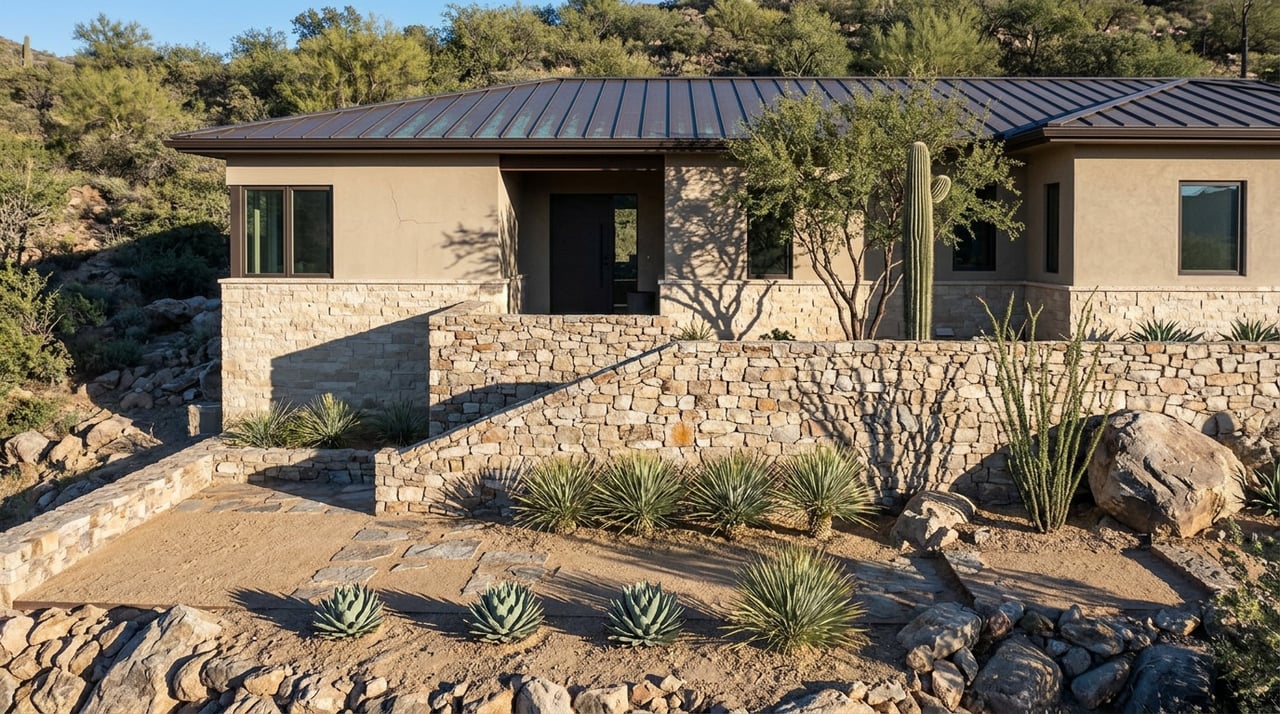
This is why two lots advertised at the same acreage inside the same guard-gated community can behave so differently in practice. A gently sloping ridgetop pad, the kind brokers flag as buildable, keeps more of its area under the 15 percent line and earns more room to build. A steep hillside lot pushes more of its footprint over that line and loses buildable area to setback and grading limits, before a shovel ever touches the ground.
The county's own grading requirements spell out the mechanism in numbers. For every 10 percent of a site that falls under 15 percent slope, the maximum allowable grading area can increase in 5 percent increments, up to a hard cap of 70 percent of the site. In plain terms: the flatter your lot actually is, once an engineer measures it, the more of it you're permitted to disturb. The steeper it is, the more of it stays locked as natural area no matter what you're willing to spend on retaining walls.
Where the Grandfather Clause Splits the Market
There is a second layer to this that matters as much as the slope math itself. The hillside ordinance's key provisions do not apply to land parcels recorded with the county recorder before July 1, 1976. Anything platted before that date, and never re-subdivided since, sits outside the modern rules entirely.
This explains a pattern longtime Foothills residents already sense but rarely see spelled out: some of the oldest, densest hillside subdivisions in the area could never be permitted today. Development this compact on this kind of slope was possible only because it was platted before the county understood the consequences of hillside building. Newer splits or multifamily development on those same parcels, if they ever happened, would trigger full compliance with today's rules.
The practical takeaway for a buyer or seller is this: a lot's age and platting history are not a nostalgic detail. They determine which rulebook applies. Some of the Foothills' 1950s-era subdivisions, including sections platted as early as 1952, may already sit on the grandfathered side of that line. A parcel split off a larger holding more recently almost certainly does not.
Two Lots, Side by Side
| Lot A: Gentle Ridgetop Pad | Lot B: Steep Hillside Parcel | |
|---|---|---|
| Average cross slope | Below 15 percent across most of the site | 15 percent or greater across most of the site |
| HDZ triggered | Only in isolated pockets | Yes, site-wide |
| Grading area allowed | Can increase toward the 70 percent cap | Held near the ordinance's baseline limit |
| Site work before a foundation | Minimal cut and fill | Retaining walls, engineered fill slopes, exposed slope planting requirements |
| Marketing language you'll see | "Buildable envelope," "single-level construction," "no heavy excavation" | "Bring your architect," "recently surveyed," references to a custom slope analysis |
Neither lot is a bad purchase. They are simply different products wearing the same acreage number, and the difference shows up in the budget before it shows up in the floor plan.
What This Costs in Practice
Because there is effectively no production building left inside the Catalina Foothills footprint, every buyer chasing new construction here is pricing a custom build. As of June 2026, land-plus-build budgets for a modest custom home in the Foothills start around $1.5 million, and hillside estate projects run well past $5 million once site engineering, grading review, and architectural design are factored in. The timeline from land acquisition to certificate of occupancy typically runs 18 to 30 months, and that window stretches further on a lot where the grading plan has to be revised to satisfy the county's slope requirements before a building permit can even be submitted.
The single-family resale market gives a sense of what buyers are competing for in the meantime. As of June 2026, the Catalina Foothills single-family median sale price sat near $735,000, with days on market averaging 73 and homes selling at roughly 96.5 percent of list price across 245 active listings. A four-bedroom home carried a median closer to $895,000, with pricing for that size ranging from about $750,000 on the community's southeast edge up past $2.5 million inside gated enclaves like La Paloma, Ventana Canyon, and Catalina Foothills Estates. None of those figures separate out which homes sit on grandfathered parcels versus lots that absorbed HDZ-driven site costs during construction, which is exactly why the underlying slope calculation matters more to a serious buyer than the comp sheet alone.
The Legal Layer Nobody Puts on the Flyer
A slope report tells you what you can build. It does not tell you what a seller is required to tell you about the land itself. Arizona has no statute mandating a general disclosure form, but its courts have filled that gap with a standard from Hill v. Jones, a case that originated with a Tucson home and termite damage the sellers knew about and never mentioned. The rule that came out of it: a seller must disclose facts known to them that materially affect the property's value and that a buyer could not reasonably discover independently.
In a hillside setting, that standard reaches further than roof leaks and cracked slabs. It can capture drainage patterns, a history of erosion, or a wash that floods during monsoon season. Pima County has specifically noted that fire history in the Catalina Mountains, including the Bighorn Fire burn scar, has increased flash-flood and mudflow risk in foothills areas downstream of the burn area. County flood maps are explicitly described as general information only, not adequate for permitting decisions, which means the map on a listing site and the actual flood status of a specific parcel are not always the same thing.
For a buyer evaluating a hillside lot, that means the slope analysis and the flood or drainage history are two separate questions that both need answers before an offer goes in, not after.
What This Means If You're Comparing Lots or Pricing a Rebuild
If you are evaluating raw land or a scrape-and-rebuild candidate in the Foothills, the acreage figure and the price per square foot are the least useful numbers on the listing. What actually determines your outcome is whether an engineer has already run the average cross slope calculation, whether the parcel predates July 1976, and whether the flood and drainage history has been independently verified rather than assumed from a map thumbnail. A lot that looks identical to its neighbor on paper can require a fundamentally different budget and timeline once that math is done.
A Few Questions Worth Asking Before You Write an Offer
Does average cross slope apply to a lot I'm buying with an existing home on it, or only to raw land? The calculation matters most when you're planning new grading, an addition, or a full rebuild. An existing home built under an older permit is generally judged against the rules in place when it was constructed, but any new grading plan triggers current review.
How do I find out a specific parcel's average cross slope before making an offer? This requires a civil engineer or licensed surveyor to run the calculation from the topography, and it is worth requesting before you're deep into a due diligence period rather than after.
Does the pre-1976 grandfather clause mean I can ignore hillside rules entirely on an older lot? Only the original chapter's specific provisions are exempted for parcels recorded before that date. Any subdivision or multifamily development on that parcel after 1976 brings the full ordinance back into play.
Comparing Foothills lots on acreage alone is comparing the wrong number. If you're weighing a hillside parcel, a scrape-and-rebuild, or a resale where the site history isn't fully documented, Mark Klugheit can help you get the slope, grading, and disclosure questions answered before you're under contract, not after. Let's Connect.